


How to Automate AI Compute Cabinet Manufacturing with an Integrated Sheet Metal Production Line
AI infrastructure is creating new demands for manufacturers of data center cabinets, server enclosures, and supporting metal structures. As production requirements evolve, manufacturers must coordinate sheet metal processing while maintaining dimensional consistency, managing labor, and meeting delivery schedules.
The challenge is not simply cutting metal faster. It is coordinating cutting, bending, welding, inspection, and assembly so that each operation supports the next. An integrated production line can help connect individual processes, reduce unnecessary material handling, and make production flow easier to manage.
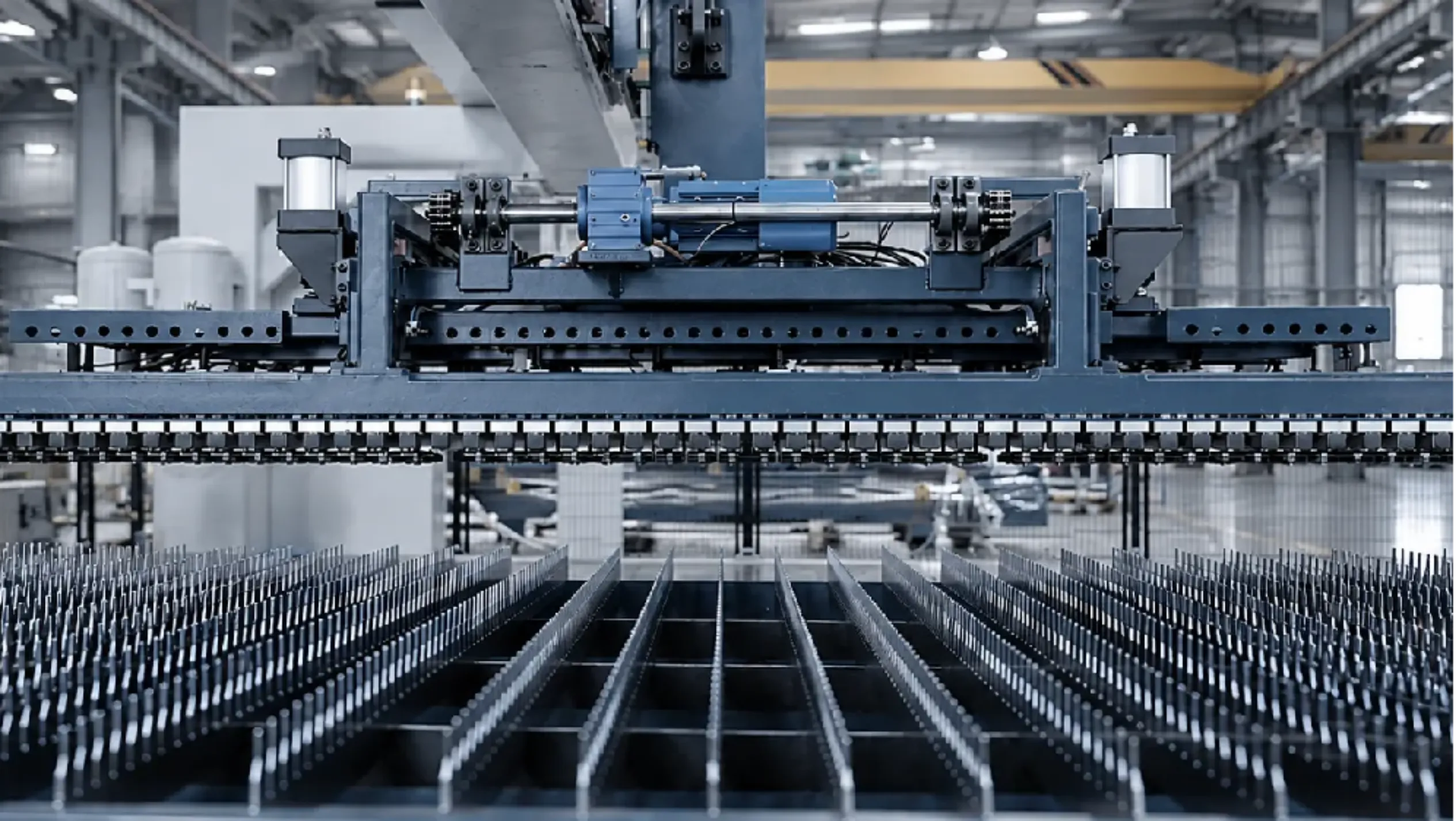
Why Is Automated Manufacturing Becoming Important for AI Compute Cabinets?
Automation can help cabinet producers manage complex workflows by connecting operations that might otherwise depend on separate machines, manual transfers, and independent scheduling. The International Energy Agency (IEA), in its Energy and AI report, estimates that global data center electricity consumption was approximately 415 terawatt-hours (TWh) in 2024 and projects around 945 TWh by 2030 in its base case. This is market context for expanding digital infrastructure—not a direct forecast of cabinet orders.
What Production Challenges Do Data Center Cabinets and AI Server Racks Create?
Data center cabinets and AI server racks require manufacturers to coordinate multiple components, maintain assembly dimensions, and accommodate different cabinet configurations without allowing work-in-progress to accumulate.
- Fragmented workflows: components move between cutting, bending, welding, and assembly departments.
- Dimensional variation: inconsistencies in cutting, forming, or welding can create alignment issues during assembly.
- Material-handling demands: manual loading, unloading, sorting, and transfers consume operator time.
- Changing specifications: different enclosure sizes, panel geometries, and structural requirements complicate setup and scheduling.
Why Can Separate Manufacturing Processes Cause Bottlenecks?
A production line can be constrained by the stage that cannot keep pace with the rest. For example, a laser cutting machine may finish panels before the bending department can process them. Parts then occupy floor space and require additional handling. Increasing cutting capacity alone may create a larger queue rather than improve finished output.
Measure cycle time, queue time, handling time, rework, and output at each major stage. These data help identify whether cutting, forming, welding, inspection, or assembly is the true constraint.
Which Manufacturing Processes Should an Integrated Sheet Metal Production Line Connect?
An integrated production line should connect the operations needed to turn raw material into a finished cabinet, with transfers coordinated around product design, material format, production volume, and the intended degree of automation.
How Do Laser Cutting, Bending, Welding, Inspection, and Assembly Work Together?
|
Production stage |
Objective |
What to coordinate |
|
Uncoiling and loading |
Prepare material |
Material supply and loading sequence |
|
Laser cutting |
Create component geometry |
Programs, part identification, downstream demand |
|
Intelligent bending |
Form panels and parts |
Bend sequences, tooling, dimensions |
|
Precision welding |
Join components |
Positioning, joint consistency, assembly sequence |
|
Inspection |
Verify critical dimensions |
Inspection criteria and correction procedures |
|
Automated assembly |
Complete the cabinet |
Component availability, fit, assembly order |
The value of integration lies in the handoffs. Inspection, for example, should identify dimensional problems before they create additional work during final assembly. [Visual placeholder: A flowchart from uncoiling and loading through cutting, bending, welding, inspection, and automated assembly.]
Where Do Material Handling and Automated Transfers Fit into the Workflow?
Material handling should be designed around how parts move between operations, because unnecessary transfers add labor, floor-space requirements, and opportunities for damage or misplacement. An automatic loading and unloading system can automate material movement at the laser cutting stage, but automating one transfer does not connect the entire factory.
Plan how parts leave the machine, where they are buffered, how they are identified, and how the next operation receives them. Include rejected parts, machine downtime, and changes in production priority. The goal is to remove handling that interrupts production—not to automate every task regardless of cost.
How Should Manufacturers Design a Sheet Metal Automation Workflow?
Manufacturers should design sheet metal automation around product requirements, production constraints, and the intended level of integration rather than choosing equipment by advertised cutting capacity alone.
When Should You Choose Automated Laser Cutting and an Automatic Loading and Unloading System?
Automated laser cutting is worth evaluating when loading, unloading, or repeated transfers limit machine utilization or place excessive demands on operators. Before investing, document:
- Materials, thicknesses, sheet formats, and component geometries.
- Shift patterns and the frequency of machine changeovers.
- Time spent loading, unloading, sorting, and moving parts.
- Machine stoppages and their causes.
- Downstream capacity available to receive cut components.
If bending and welding already work smoothly, automating the cutting stage may be a sensible first step. If queues and inconsistent handoffs disrupt several departments, broader integration may address more of the underlying problem.
When Are 2D Laser Cutting and Tube Laser Cutting Machines Appropriate?
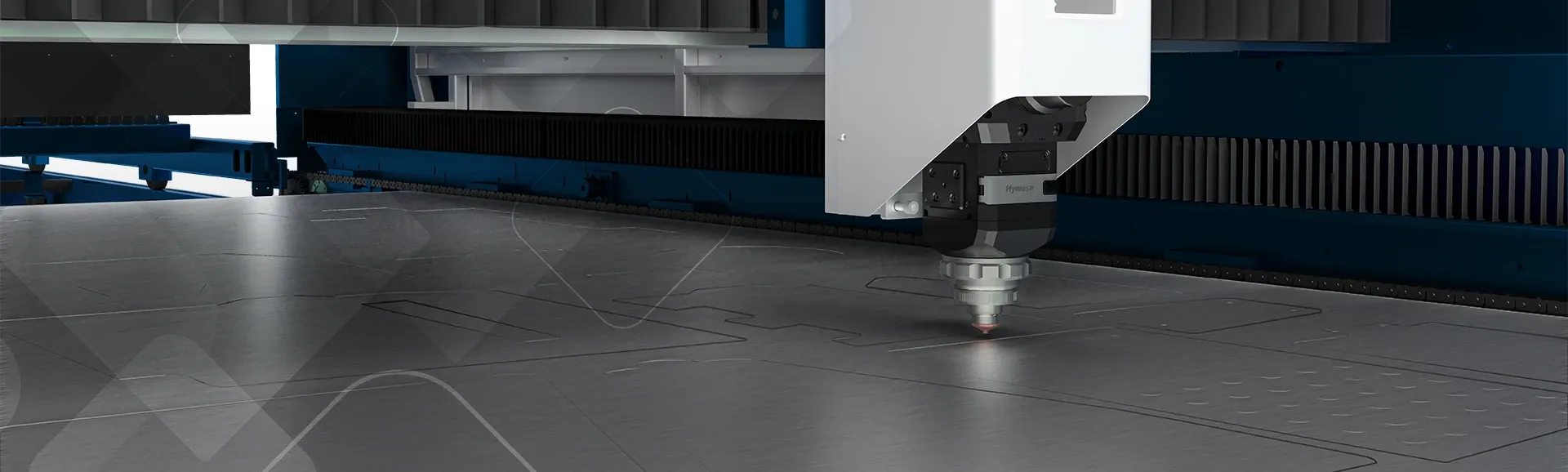
A 2D laser cutting machine is suited to flat sheet components and plate parts, while a tube laser cutting machine is intended for tubular materials and structural profiles.
|
Equipment type |
Typical application |
Selection consideration |
|
2D laser cutting machine |
Flat panels, covers, brackets, sheet metal parts |
Material, thickness, geometry, cutting capacity |
|
Tube laser cutting machine |
Tubes, pipes, structural profiles |
Profile dimensions, material, geometry |
|
Loading/unloading automation |
Material movement around laser cutting |
Handling needs, floor space, compatibility |
|
Integrated fabrication line |
Connected cabinet-production stages |
Product mix, line balance, inspection, integration |
Some factories produce both flat enclosure panels and tubular frames. These may require separate processing streams that converge during welding or assembly. Choosing equipment for the actual component mix avoids forcing different materials through an unsuitable process.
How Can Manufacturers Balance Production Volume and Product Variation?
Manufacturers should balance line capacity against the range of cabinet configurations they expect to produce. High-volume, standardized products may justify tightly coordinated automation, while smaller batches with frequent design changes may need flexible programs, tooling, and changeovers.
Evaluate representative product families, including common variants, difficult components, material changes, and realistic schedules. This helps determine whether the proposed line can support actual orders without creating bottlenecks at bending, welding, or assembly.
How Does Hymson Laser Machinery’s MGX Solution Support AI Compute Cabinet Manufacturing?
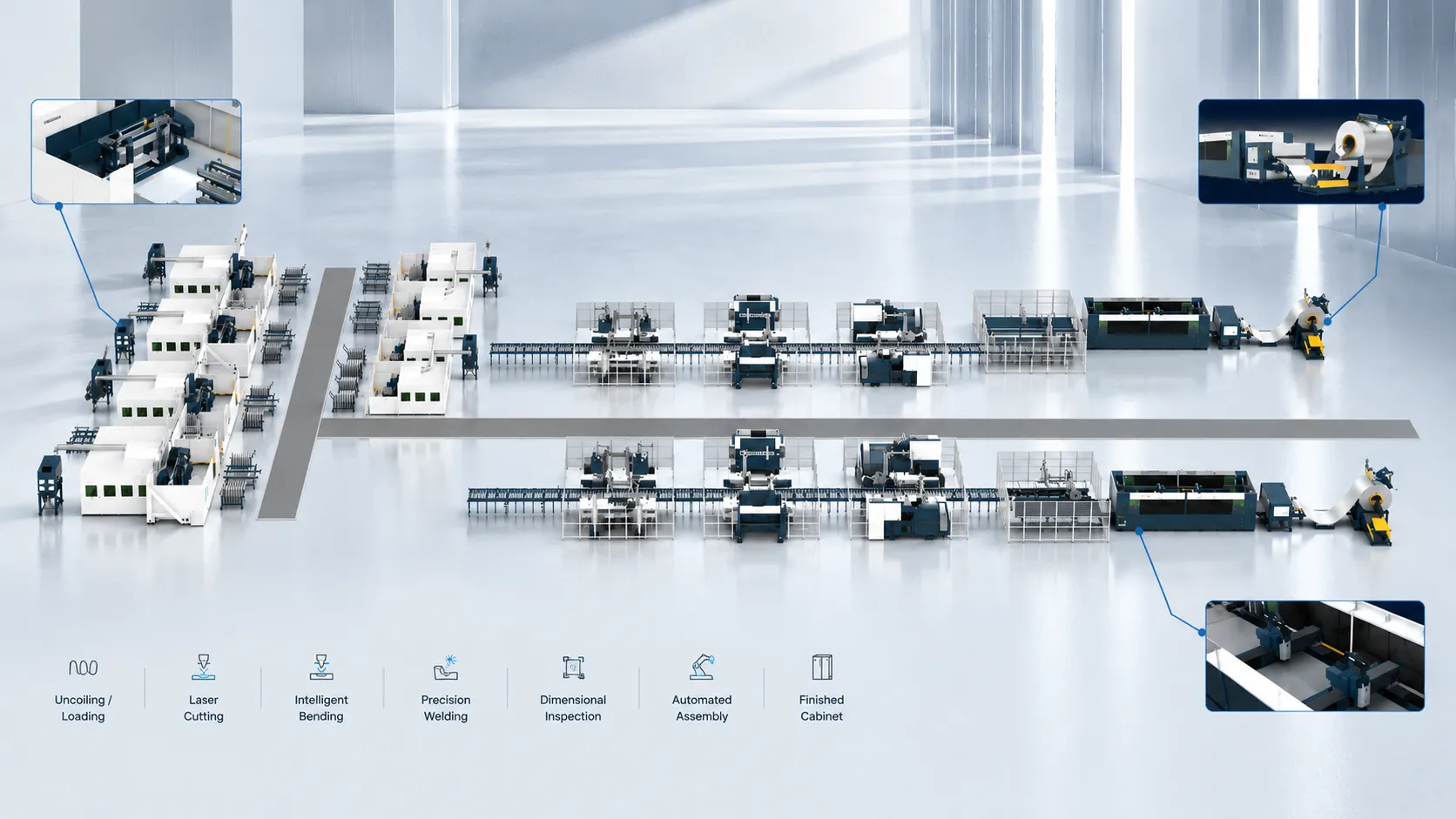
Hymson Laser Machinery’s MGX Automated Sheet Metal Fabrication Solution for AI Compute Cabinets is designed to connect major cabinet-production operations within one coordinated manufacturing system. The official MGX page identifies uncoiling and loading, laser cutting, intelligent bending, precision welding, dimensional inspection, and automated assembly as stages in the solution.
What Does the MGX Automated Sheet Metal Fabrication Solution Integrate?
MGX brings multiple fabrication stages into a coordinated workflow. Hymson Laser Machinery describes end-to-end automation, continuous production, high-precision processing, and flexible manufacturing with rapid changeovers as key characteristics.
- End-to-end automation across major fabrication stages.
- Coordinated production and material handling intended to support smoother workflow transitions.
- Cutting, bending, welding, and dimensional inspection to support consistent processing quality.
- Flexible manufacturing for different cabinet specifications and changing requirements.
These capabilities are relevant to factories seeking to reduce disconnected handoffs and coordinate the path from raw sheet metal to finished cabinets. Buyers should confirm the proposed configuration, supported materials, cycle times, inspection methods, and integration requirements for their own product range. The published product information does not establish a universal output rate or quantified cost reduction for every factory.
How Do Hymson Laser Machinery’s Other Equipment Options Fit Different Production Needs?
Hymson Laser Machinery’s 2D laser cutting machines cover applications involving thin sheets, thick plates, and complex sheet metal parts. Its tube laser cutting machines address small and medium tubes, large pipes, and structural profiles. The company’s automation portfolio also includes the HyAuto automated loading and unloading solution for laser cutting.
These options address different scopes: a standalone machine, a cutting cell with loading automation, or a fully integrated fabrication line. The appropriate choice depends on the factory’s current constraints and its production plans.
What Should Buyers Verify Before Investing in an Integrated Production Line?
- Which cabinet sizes, materials, and thicknesses can the proposed configuration process?
- What output can be demonstrated using representative parts?
- How are dimensional inspection results recorded and handled?
- What happens when a workstation stops or requires maintenance?
- Which transfers are automated, and which still require operators?
- What installation, training, maintenance, and integration support is included?
A production demonstration using representative components helps buyers compare proposed performance with actual requirements and identify bottlenecks before finalizing specifications and budgets.
Conclusion: How Can Manufacturers Plan Their Next Step Toward Automated Cabinet Production?
Manufacturers can automate AI compute cabinet manufacturing most effectively by treating production as a connected workflow rather than a collection of individual machines. Map the process from material preparation through final assembly, identify queues and handling-intensive tasks, and determine which quality problems create rework.
Hymson Laser Machinery’s MGX solution is an option for manufacturers seeking to coordinate cutting, bending, welding, dimensional inspection, and assembly. Its separate 2D laser cutting, tube laser cutting, and loading and unloading automation offerings may also suit factories with more specific requirements.
Before selecting equipment, establish measurable production targets, validate the proposed configuration against representative parts, and compare total investment with expected operational outcomes. The most effective sheet metal automation strategy addresses the factory’s actual constraints, supports its product mix, and provides a measurable path toward more predictable production.